Showing posts with label 2nd Grade. Show all posts

Wednesday, August 19, 2015

Number Racks!

Today was an exciting day in 1st grade because not only did students get introduced to the number rack, but they also got to make their own! 2nd grade also got to do this earlier in the week.

Students were so interested in the number rack and could not wait to show their combinations on the large teacher model. It is incredible how much the number rack helps students how numbers can be broken down in many ways.


Tip: Don't worry about your students getting the number rack that they made each time you work with them in class. They are just a class tool that everyone contributed to building, so it doesn't matter if they are using their own or not! Many teachers chose to not even have student's write their names on them - this will really help with efficiently distributing them for lessons (especially since they are frequently used for quick warm ups!)

You have a large display Number Rack that came in your kit, but the Math Learning Center also has an app you can download. 

Here is a great video about how to use Number Racks with students. 

Finally, here is a link to more great activities you can try!


Tuesday, April 28, 2015

Bridges Implementation: Four Tips

We are so excited to begin using Bridges as our primary resource for teaching math next year! There will definitely be some bumps along the way, but we know it is going to be great for our kids. I frequently read the Bridges Implementation blog and want to share some tips that were posted by a teacher implementing Bridges for the first year.

Tip #1: Routines for Talking & Sharing
Think, pair, shares are a major part of the Bridges math lesson. Make sure you set up strong routines for sharing with partners and sharing with a whole class. When time to share as a class, think strategically about who you want to share: random by Popsicle stick? student who you listened in on during the pair portion?
Tip #2: Select which problems you will work through
Time is going to be tight. We are taking lessons that were intended to be taught in a whole group model and putting them into a rotational model. We will have to keep lessons moving, and may not have time to do all the examples every day. When reading the lessons, think about which problems are most important to the days work. Be strategic with your time!
Tip #3: Use your small group time well!
There will be recommendations in unit plans for what to do during small groups, but it is up to you as the teacher to know your kids and what they need. Make the most of your small group time, and differentiate for each group.

Tip #4: Know the objective for the day
Bridges does an amazing job of constantly introducing and spiraling related concepts in a days lessons, but know exactly what your kids need to know on a given day, from a given lesson. Having a clear vision of the goal for the day will help you cut back the lesson and fit in the allotted time and keep your lesson focused. 


Tuesday, April 21, 2015

Awesome Resource: Word Problem Generator

Last week in Boston, I was able to hear Greg Tang speak and it was incredible! I could have listened to him talk about strong math instruction all day. Besides being a great speaker and mathematical thinker, Greg Tang also write children's books about math. If you have not checked them out, I highly recommend them. A few of my favorites...


During his talk, he shared a new free resource on his website

With this tool, you can select an operation, problem time, location of the unknown, and the number range. You can either print a list of problems or you can display to project and work on together as a class. Students can also use this independently. There is a hint button that will give them a model to help solve. It is a really awesome tool!


Monday, April 20, 2015

Guess My Number

Last week, I was in Boston at the NCTM conference and learned lots of great things that I am excited to share. 1 great session was hosted by Math Solutions (Marilyn Burns) company and focused on using the ten frame to play games and build numeracy. This game is really simple, does not require a lot of prep, and has lots of built in differentiation opportunities.


Game 1: Guess My Number with the Ten Frame

Materials Needed: Ten Frame, two colored chips

In this activity, you will give students a series of clues and they will build a guess of your number on their frame. After each clue, students should have the chance to talk through their predictions and why it is a good guess. Really focus on the discussion and why their predictions are changing.

Here is an example string of clues:
1) My number is more than 6
2) My number is less than 9
3) My number is even

You can mix the clues up to review any content that your students are struggling with (doubles facts, multiples, 1 more/ 1 less, so many possibilities!) Make sure your last clue gives them enough information to figure out the number.


Monday, March 9, 2015

Geometry Password


There are a lot of math topics in elementary school that require constant spiraling for students to retain the information. Shapes are on of those skills that just need to be part of a routine and frequently referenced for students to learn and remember the information. Mrs. R at KACE came up with a great routine to help her 2nd graders practice naming shapes. 

Each time they line up to enter the room, they must name a 2D and 3D shape to enter, both fun and useful review :) 


Wednesday, February 18, 2015

Behavior Routines to Practice Challenging Concepts

In the classroom, there are so many issues that come up that teachers create special incentive systems to help motivate better choices.  Having a routine that students practice daily really helps them to focus on specific behaviors and can be used to build their skills on more challenging math topics. In 2nd grade, some students were having trouble during computer time. They were not treating the computers well, purposely causing them to malfunction, and not focusing on iStation or ST Math.

To help with this, Ms. M decided to give students points each day that they showed integrity with the computers. Rather than giving them a tally mark or coloring in a box each day, she used it as a teachable moment with fractions. See below for how class points are tracked and all the rich math conversations and practice that can be incorporated in this behavior routine. Also, notice that the reward is also academic rather than a treat or non academic time :) Great ideas, Ms. M!


Sunday, February 15, 2015

Focus on Fluency: Red Light/ Green Light: Couting by Ones

Counting practice daily is really important because it helps students build and maintain counting skills, as well as serves as a foundation for adding and subtracting within 100.

Here is a quick and easy game that will both practice counting and help kids get their wiggles out.

1) Say a number between 1 and 100.
2) When you say "green light" students begin running in place and counting aloud together, beginning with the number you said.
3) When you say "red light" students stop counting and freeze.  Any students who are still counting or moving after you say "red light" sit down until the next game.
4) Continue playing starting with a new number each time you say "green light".
5) Play until only a few students are left standing, then have everyone stand and play again.

A suggested sequence of start numbers: 15, 28, 35, 48, 55, 68


Thursday, February 12, 2015

Focus on Fluency: Shake Those Disks

Here is another fun activity from Eureka math that can be used to build fact fluency. This one takes a bit of prep work and probably about 5 - 10 minutes to play.

Students will play in partners, for each pair you need:
(6) two color disks, beans, or coins (you can make them by spray painting one side of beans)


(1) Shake Those Disks 6 board

Instructions:
1) Once students are in partners, tell them they will take turns as the "shaker" and "recorder".
2) The shaker shakes the beans and tosses them on the table.
3) The recorder then records the roll on the Shakes Those Disks board.
Example: If the shaker tolls 4 red and 2  white, the recorder puts an X on the graph above the 4 and 2 number bond.
4) Players switch roles.

You can play this with any amount of beans, depending on which facts you want to focus on. The goal is for students to build automaticity with facts within 10. 

Have fun!

Tuesday, January 20, 2015

Focus on Fluency: Happy Counting

I have been reviewing Eureka Math to see if it would be a good resource for our teachers to use next year. One strength that the program has is fluency routines. Each day there are awesome routines that teachers can use to build fluency in counting and operations. Here is 1 of them:

Happy Counting

Explanation of Signals:

Count up                                          


Count down                                              


Stop


1) Tell students what you want them to count by and what number to start on (example: by ones starting at zero)
2) Point up as students count, signal to stop, and switch directions. Continue, mixing up.
3) Students play for 30 seconds with a partner.


This could also be a fun brain break for students to get up, move around, and play with friends. Try it out and let me know what you think!

Tuesday, December 16, 2014

Independent Practice Resource

We are currently looking into several different curricular resources to use for Elementary Math next year. One of the resources that we are looking at has some great workbooks available for free online!

We would love for you to take a look, use in your classroom, and let us know what you think!


Here is the link

Wednesday, December 10, 2014

Student Goal Setting

This week while visiting Ms. D's 4th grade class at KACD I got to see students setting and owning their own goals for the upcoming IA. They set at attainable goal and came up with awesome action items to help them achieve their goals.

It was amazing to see the level of ownership that students are taking over their learning and this is definitely a skill they will need in college - setting goals and creating a plan.

Thanks for sharing with us, Ms. D!!

Tuesday, November 25, 2014

NWEA RIT to Resource

Last week, I spent several days at the NWEA Fusion conference learning about MAP from both the company who makes it (NWEA), as well as other users. I am so excited to share all that I learned with teachers to help set our students up for MAP success.

One new tool I learned more about is "RIT to Resource". It is a website that allows teachers or parents to input a student's RIT score by strand and access tons of free resources aligned to that band level. It is only available for MAP 2 - 5 and you need the RIT score by band handy. It is an awesome tool, so check it out!

Happy Thanksgiving! 

Thursday, November 20, 2014

Math Races

If you ask middle school math teachers one thing they wish their students knew from elementary school, almost all of them will say math fact fluency. It is challenging to balance teaching conceptual math and building fact fluency, but there are lots of fun ways to practice and build automaticity with math facts. 

Last week at our Math Instructional Leader's meeting, Ms. G at KACD shared her awesome Math Race routine. 

See below for the details from Ms. G :)
Math Races
Materials:
·        Flashcards
o   +1 through + 9, -1 through -9, x 1 through x 12
·        Tests (www.math-drills.com; single addition/subtraction/multiplication facts arranged horizontally) *cut in half vertically so each sheet has 2 columns of facts for students
o   +1 through + 9, mixed addition, -1 through -9, mixed subtraction, x 1 through x 12, mixed multiplication
·        Tracker
·        Timer

Routine:
·        Call each level at a time
·        Students walk to pick up their tests FACE DOWN
·        Students put their paper on their desk FACE DOWN
·        Students write their name on the back
·        Students sit in STAR (cannot touch their paper or pencil)
·        Once all students have a test and are sitting in STAR, put 3 minutes on the timer
·        Say “start!” – students should start right away
·        Once the timer goes off, pencils should go down immediately and papers should be put in the middle

Grading:
·        Students must fill the entire sheet and only have 5 free. That means, they can leave 5 blank or get 5 wrong. If it’s more than 5, they didn't pass.
·        If a student passes, celebrate with 3 snaps. If a student doesn't pass, send them positive/good try vibes.
·        If a student passes, they should put a sticker or a check on the track and swap their flashcards. If a student doesn't pass, they will try again next week!

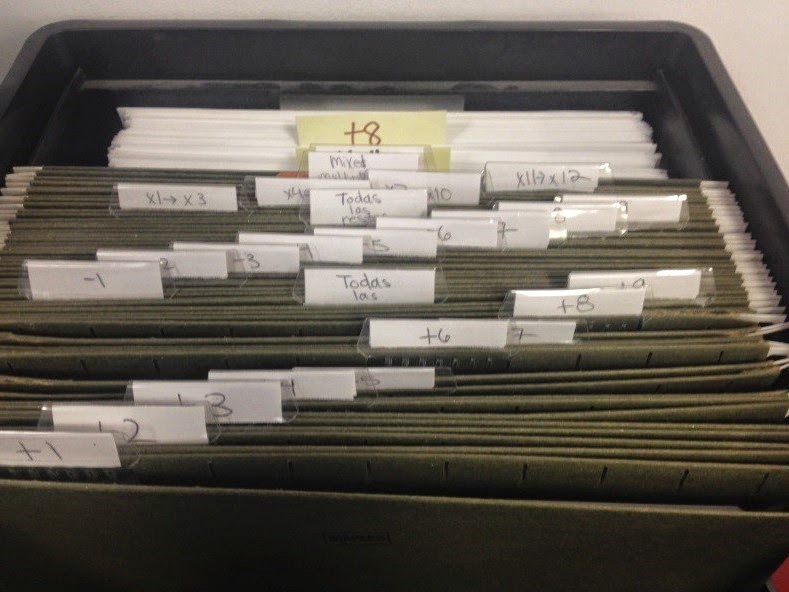
Storing Flashcards

Storing Tests


Trackers


Thanks Ms. G for sharing your awesome routine with us!! 

Wednesday, November 12, 2014

Time for Review!

Over the next couple weeks, all grade levels are starting to review content from the first Semester in preparation for IA 2. Review days can be tricky, but can also be really fun. Some review days are taken up with lessons that need to be retaught using a full lesson cycle. Other days can be more of a mixed review, so here are some ideas for the days that are mixed:


  • Break your kids into rotation groups based on what they need to practice as measured by unit tests. You can pull a group to practice addition and subtraction, another to practice geometry, and a third to practice multiplication. It is a great way to give your students exactly the review that they need. 
  • Create a grid where students can walk around and "Find someone who" knows how to solve a problem on their paper. Here is an example:
  • Create a Jeopardy game with practice review questions that students can work to solve.
  • Buddy Problem Solving: Create a packet of problems that get progressively harder. Students work with leveled partner to get through as many as they can. 
  • Create review centers that students can practice, based on what they need to work on. Math Wire & K-5 Math teaching resources have a ton of good ones for free. 

I will keep an eye out for some awesome review happening in your classroom to share with others!

Tuesday, November 11, 2014

Probability

Probability is really fun to teach...will it probably happen? Probably not? It is so applicable to real like and they love predicting the outcomes of things.

There are a ton of different activities involving skittles and spinners, but here are a few of my favorites:


  • Give out raffle tickets throughout the unit and talk about how they can increase their chances of winning. This is a great way to invest them, build background knowledge, and help them understand probability based on experience


Enjoy!

Thursday, October 30, 2014

Chartchums: Guide to Great Anchor Charts

Anchor charts are a great tool in early elementary classrooms. They give students visual reminders, record the learning, and are great reference tools. My favorite resource for charting is the website Chartchums. They have tons of examples of great charts on the blog, such as the one below.
They also wrote an entire book  devoted to charting in the K-2 Classroom focusing on Math, Science, and Social Studies. Pretty awesome!

Happy charting!

Thursday, October 23, 2014

Using Cubes for Problem Solving

This week Mrs. Doyle and I had a great chance to see some CGI problem solving in action. KIPP DC has done a lot of work this year to push their students thinking and problem solving skills. One big takeaway we had is that students need cubes to directly model the problem. Understanding the context of the problem and being able to show what is happening is crucial for student understanding.

The cubes should be readily available and in towers of ten, of all the same color. We keep them in towers of ten to help students with base ten thinking. When they always start with groups of ten, they are much more likely to use base ten strategies to make counting and operations more efficient.

Cubes should always be out and being used during story problem time for K-2 and can be easily stored and hassle free!


As you can see, 1 black cube got mixed into the blue cube box. You have to really work with students on keeping them organized and putting them back into tens at the end of the lesson, but that can definitely do it!

Thursday, October 16, 2014

Edmodo: Quick and Easy Exit Tickets!

Edmodo is an amazing resource that Ms. Douglass recently introduced me to. This website is completely free. You create a teacher profile and then add your students to your class to give them access. You can then give them assignments to complete electronically and they even have a bank of TEKS aligned test questions!

Ms. Douglass creates her exit tickets daily using the TEKS bank of questions and has her students do those as their first activity on computers each day. It has made managing exit tickets for 120 students possible! 

It is like the classrom version of facebook :) 
Ms. Douglass and I both highly recommend checking it out. 


2nd Grade: Addition & Subtraction

Like 1st grade, 2nd grade will spend a majority of 2nd quarter working on addition and subtraction. In 1st grade the focus is on developing the concept of addition and subtraction, as well as fact fluency within 20. In 2nd grade, students will be modeling addition and subtraction, and adding up to 4 digit numbers with regrouping!

During Q2, we are going to really focus on 2 digit numbers, both modeling and the traditional algorithm. We will return to addition and subtraction during Q3 to build up the number of digits in the numbers students are working with.
This is a really excellent article to build your own knowledge of column addition and subtraction.

The first step in planning for such a meaty unit is to create a vision of success. What will your students be able to do at the end of the unit. We have the IA, but we want to make sure we are breaking down the skills that students need. We also do not want to wait until the end of the quarter to assess.

Here is a sample unit test for addition and subtraction.

Breaking down addition and subtraction into daily objectives can be a bit challenging. Here is an example of how I broke them down and the sequence that I would teach them.

Students are going to start by wanting to directly model because that strategy was effective with smaller numbers. The goal is to extend this understanding to directly modeling with place value blocks, rather than drawing 84 circles.  Using graphic organizers will help them effectively use the blocks to add and subtract.
Surfin Through Second has some great activities

Once they understand how to add and subtract place value blocks, they are ready to use the algorithm as way to record what they are doing with the blocks.

Once you have your unit level planning done, here are some resources to help with daily planning:

It is important to teach addition and subtraction together so students understand the relationship between them. Adding to check your subtraction is a great strategy to ensure you got the correct answer and to practice addition while working on subtraction. Here is a center that focuses on checking subtraction with addition.

This unit is going to be very heavy on word problems because students rarely use subtraction and addition with context. Resources for teaching problem solving are coming soon.

Here are some great centers and activities, check out Stage E

Mrs. Lemons Blog has some amazing resources for teaching all things 2nd grade, here are some addition and subtraction freebies
Here is a great video modeling how to encourage students to use multiple strategies. With the new TEKS students need to be able to model with pictures and place value blocks, not just the traditional algorithm. 

Brain Pop Jr is always a great way to reinforce these concepts during transitions or down time. Email Amanda if you need the KAPS login :) 

I will continue to hunt for high quality resources and share what I find!

Excellent Resource full of Centers!

Last week, Mr. Fried and I spent 2 days visiting KIPP Houston schools and collaborating with their Elementary Math Specialist. We learned a lot from them and really look forward to continuing our relationship and sharing awesome resources.

The following website came really highly recommended. It is a collection of centers and activities that are aligned and grouped by common core standards (which are pretty similar to the new TEKS). Most of their teachers created folders for each standard and organized hard copies of the centers to easily grab and put into page protectors.


Here is the link, definitely book mark it and check it out for quick, great resources!

http://www.k-5mathteachingresources.com/