Showing posts with label Resources. Show all posts

Tuesday, April 21, 2015

Awesome Resource: Word Problem Generator

Last week in Boston, I was able to hear Greg Tang speak and it was incredible! I could have listened to him talk about strong math instruction all day. Besides being a great speaker and mathematical thinker, Greg Tang also write children's books about math. If you have not checked them out, I highly recommend them. A few of my favorites...


During his talk, he shared a new free resource on his website

With this tool, you can select an operation, problem time, location of the unknown, and the number range. You can either print a list of problems or you can display to project and work on together as a class. Students can also use this independently. There is a hint button that will give them a model to help solve. It is a really awesome tool!


Tuesday, January 20, 2015

Cognitively Guided Instruction Book Study

Since winter break, many more teachers have begun working on a CGI problem solving block. It is so exciting to see the work that our students are doing, all the strategies that they are showing, and the conversations that they are having about Math. With all these new trials, there have been many questions come up that have pushed my own knowledge of CGI.

I got the newest CGI book a couple months ago and reading it has been on my list for quite some time. I know that there are some amazing things in it and I cannot wait to learn more about CGI and continue to work with our teachers. I am going to read each chapter and create a post with a summary of that chapter, key takeaways, and some questions to think about. I think it will be really helpful to have a reference for what is in the book and where to find information about certain topics. I will begin reading and posting tomorrow and go chapter by chapter through the book.

Please feel free to order the book and read along with me :)


Tuesday, December 16, 2014

Independent Practice Resource

We are currently looking into several different curricular resources to use for Elementary Math next year. One of the resources that we are looking at has some great workbooks available for free online!

We would love for you to take a look, use in your classroom, and let us know what you think!


Here is the link

Tuesday, November 25, 2014

NWEA RIT to Resource

Last week, I spent several days at the NWEA Fusion conference learning about MAP from both the company who makes it (NWEA), as well as other users. I am so excited to share all that I learned with teachers to help set our students up for MAP success.

One new tool I learned more about is "RIT to Resource". It is a website that allows teachers or parents to input a student's RIT score by strand and access tons of free resources aligned to that band level. It is only available for MAP 2 - 5 and you need the RIT score by band handy. It is an awesome tool, so check it out!

Happy Thanksgiving! 

Thursday, October 30, 2014

Chartchums: Guide to Great Anchor Charts

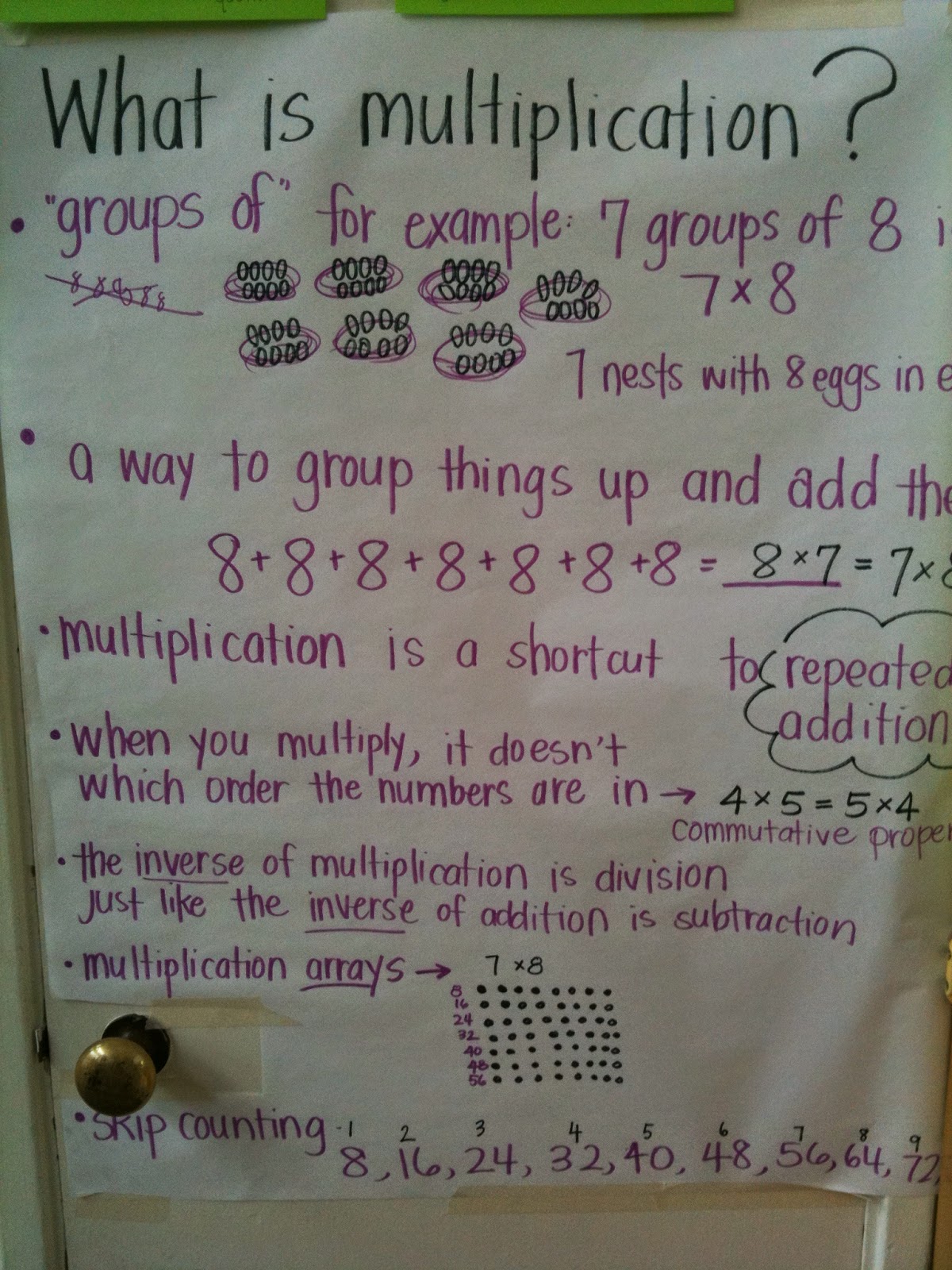
Anchor charts are a great tool in early elementary classrooms. They give students visual reminders, record the learning, and are great reference tools. My favorite resource for charting is the website Chartchums. They have tons of examples of great charts on the blog, such as the one below.
They also wrote an entire book  devoted to charting in the K-2 Classroom focusing on Math, Science, and Social Studies. Pretty awesome!

Happy charting!

Monday, October 27, 2014

3rd & 4th Grade: Teaching Student Centered Mathematics

One of the best resources for teaching conceptual math, in my opinion, is Teaching Student Centered Mathematics.


It breaks down the building blocks of math understanding and how to teach concepts conceptually, rather than through procedures.

Today I came across the workbook that goes along with this amazing resource, available online. It is the 3rd - 5th grade edition and has some excellent activities.
Check it out!!

Thursday, October 16, 2014

Edmodo: Quick and Easy Exit Tickets!

Edmodo is an amazing resource that Ms. Douglass recently introduced me to. This website is completely free. You create a teacher profile and then add your students to your class to give them access. You can then give them assignments to complete electronically and they even have a bank of TEKS aligned test questions!

Ms. Douglass creates her exit tickets daily using the TEKS bank of questions and has her students do those as their first activity on computers each day. It has made managing exit tickets for 120 students possible! 

It is like the classrom version of facebook :) 
Ms. Douglass and I both highly recommend checking it out. 


3rd Grade: Multiplication & Division Facts

During Q2, 3rd graders will be working on multiplication and division facts. This is such a fun unit because students are super invested in learning to multiply and divide (although I am not sure why they think it is so cool).

It is really important to build a solid conceptual base for multiplication and division before moving to fact memorization. It is also key that students begin working with problems in context from the very beginning.

This book is a really great resource for how to teach multiplication and division and a suggested order. The entire book is available online for free, which is amazing!!!

Here are some example anchor charts created between the teacher and students to activate prior knowledge and outline multiplication and division strategies.


Encouraging students to use multiple strategies from the beginning will help prevent them from over-relying on one strategy. Here is an example problem solving template that requires them to show their work in multiple ways. 

Once students understand conceptually how to multiply and divide. They need to practice multiplication facts. I usually had them focus on multiplication facts and use fact families to help with division. Once multiplication was introduced, 4 in a Row, can be a permanent classroom center or game for early finishers. It is a really fun way to practice that encourages strategic thinking. 

Here are directions for how to play:
1) Player one starts by putting paper clips under two numbers in the row below the board
2) The numbers are multiplied and the product on the answer board is covered with a counter of their chosen color. 
3) Player two moves only one of the paper clips to a new number in the row beneath the board. The new combination is multiplied together and the answer is covered with a counter of their chosen color.
4) Play continues until one player has four of their counters in a row vertically, horizontally, or diagonally. 
5) If the answer to multiplying two paper clips together is already covered the player loses that turn. 

There are so many great resources for teaching multiplication and division, I am excited to share even more as the unit progresses :)

2nd Grade: Addition & Subtraction

Like 1st grade, 2nd grade will spend a majority of 2nd quarter working on addition and subtraction. In 1st grade the focus is on developing the concept of addition and subtraction, as well as fact fluency within 20. In 2nd grade, students will be modeling addition and subtraction, and adding up to 4 digit numbers with regrouping!

During Q2, we are going to really focus on 2 digit numbers, both modeling and the traditional algorithm. We will return to addition and subtraction during Q3 to build up the number of digits in the numbers students are working with.
This is a really excellent article to build your own knowledge of column addition and subtraction.

The first step in planning for such a meaty unit is to create a vision of success. What will your students be able to do at the end of the unit. We have the IA, but we want to make sure we are breaking down the skills that students need. We also do not want to wait until the end of the quarter to assess.

Here is a sample unit test for addition and subtraction.

Breaking down addition and subtraction into daily objectives can be a bit challenging. Here is an example of how I broke them down and the sequence that I would teach them.

Students are going to start by wanting to directly model because that strategy was effective with smaller numbers. The goal is to extend this understanding to directly modeling with place value blocks, rather than drawing 84 circles.  Using graphic organizers will help them effectively use the blocks to add and subtract.
Surfin Through Second has some great activities

Once they understand how to add and subtract place value blocks, they are ready to use the algorithm as way to record what they are doing with the blocks.

Once you have your unit level planning done, here are some resources to help with daily planning:

It is important to teach addition and subtraction together so students understand the relationship between them. Adding to check your subtraction is a great strategy to ensure you got the correct answer and to practice addition while working on subtraction. Here is a center that focuses on checking subtraction with addition.

This unit is going to be very heavy on word problems because students rarely use subtraction and addition with context. Resources for teaching problem solving are coming soon.

Here are some great centers and activities, check out Stage E

Mrs. Lemons Blog has some amazing resources for teaching all things 2nd grade, here are some addition and subtraction freebies
Here is a great video modeling how to encourage students to use multiple strategies. With the new TEKS students need to be able to model with pictures and place value blocks, not just the traditional algorithm. 

Brain Pop Jr is always a great way to reinforce these concepts during transitions or down time. Email Amanda if you need the KAPS login :) 

I will continue to hunt for high quality resources and share what I find!

Kindergarten: Teaching Teen Numbers

Quarter 2 in Kindergarten is focused on extended student's number sense to 20. Many of the objectives are repeated, just going to higher numbers.

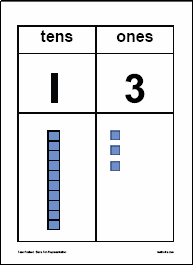
A big concept this quarter will be teen numbers. These tend to be tricky for students. Here are some resources to help teach them:

Here is a great video on teaching teen numbers

Math Wire has some really excellent resources that explain how to attach place value meaning to the teen numbers from the beginning.
Although the Harry Kindergarten Music songs are not super conceptual, they sure are catchy...


Using a double ten frame mat will really help students visualize teen numbers as a ten and some more.
Source: The Kinder Garden
The Math Wire page has some great activities that can be used as centers, small group, or whole group guided practice. I especially like the teen numbers book that teaches them as 10 + ___ = ____

So excited to see our Kindergartners know all about numbers up to 20!

Excellent Resource full of Centers!

Last week, Mr. Fried and I spent 2 days visiting KIPP Houston schools and collaborating with their Elementary Math Specialist. We learned a lot from them and really look forward to continuing our relationship and sharing awesome resources.

The following website came really highly recommended. It is a collection of centers and activities that are aligned and grouped by common core standards (which are pretty similar to the new TEKS). Most of their teachers created folders for each standard and organized hard copies of the centers to easily grab and put into page protectors.


Here is the link, definitely book mark it and check it out for quick, great resources!

http://www.k-5mathteachingresources.com/

Wednesday, October 15, 2014

1st Grade: Addition and Subtraction

Teaching the basics of addition and subtraction is a huge responsibility for 1st grade teachers. This is where the foundation is laid that they will need to be successful in Math.

With that said, here are some resources to help teach addition and subtraction to 1st graders :)

Here are some great books and articles that have a ton of excellent resources on teaching early addition and subtraction.


Here are a few awesome Math Start read alouds that can be used both as a literacy read aloud and to reinforce the math concepts:
·         Animals on Board (addition)
·         Elevator Magic (subtraction)
·         Mall Mania (addition strategies)

Great resources to use for student work or centers:

*This activity is great for small group or an independent work center. Students use 2 different colored cubes to make different combinations and record the addition sentences. 

*This is a really tricky concept and this video explains it pretty well and has some great visuals of moving 1 over to complete the ten frame. It might be a bit too complicated to show students but it gives great ideas on how to teach it and showing students parts of it with strong models could be really helpful. 

Here are resources divided by topic:

Making Ten
·         Quick blog post about importance of ten: http://mathcoachscorner.blogspot.com/2012/05/importance-of-10.html
·         http://www.accomplishate.com/preschool/printables/make6-10.pdf Page 5 is a great organizer that can be used with 2 different colored unifix cubes to generate number sentences equal to ten

  Using Ten to add 9
·         http://www.brainpopjr.com/math/additionandsubtraction/makingten/preview.weml BrainpopJr video about making 10, could work well  with higher groups, again might go over their heads but has some cool visuals
·         The first few pages could be good homework for this unit https://irieclass.wikispaces.com/file/view/SLeveled+Problem+Solving+and+Homework-Grade+2.pdf 

  Fact Families
·         http://guidedmath.wordpress.com/2010/04/01/teaching-fact-families-in-guided-math-groups/ Progression on teaching concrete to pictoral to abstract (If you scroll down this page there are a TON of great resources
·         I especially like this awesome conceptual lesson http://illuminations.nctm.org/Lesson.aspx?id=329