Showing posts with label Addition. Show all posts

Tuesday, April 21, 2015

Awesome Resource: Word Problem Generator

Last week in Boston, I was able to hear Greg Tang speak and it was incredible! I could have listened to him talk about strong math instruction all day. Besides being a great speaker and mathematical thinker, Greg Tang also write children's books about math. If you have not checked them out, I highly recommend them. A few of my favorites...


During his talk, he shared a new free resource on his website

With this tool, you can select an operation, problem time, location of the unknown, and the number range. You can either print a list of problems or you can display to project and work on together as a class. Students can also use this independently. There is a hint button that will give them a model to help solve. It is a really awesome tool!


Wednesday, October 29, 2014

1st Grade: Fact Fluency

Addition and subtraction fact fluency is challenging to teach because students need a lot of practice and cannot be expected to know all their facts at the end of a single lesson. Having a bilingual model with 2 classrooms has a ton of advantages, with one being an additional math block to work on number fluency and problem solving. While students are working on fact strategies in the primary language of instruction, there are several routines that can be done in the supporting language to push them to mastery of these important facts.

Below are 3 very important types of facts and a couple routines that could be done daily to practice:


  • Making Ten
    • Students find a partner on the carpet. Partner A hold up any amount of fingers that they choose. Partner B holds up the rest of the fingers necessary to make 10 and says the number sentence.
Example:
Student A holds up 4 fingers
Student B holds up 6 fingers and says "4 and 6 is 10"
Then students switch and partner B holds up fingers first
    • Teacher flashes a ten frame and students hold up how many more they need to make 10.

Example:
Teacher shows the following ten frame:
Students hold up 1 finger, and together say "9 and 1 is 10"


  • 10 more/ 10 less
    • Practice counting by tens, starting with any number on the hundreds chart.
Example:
Point to 6 on the hundreds chart and students count, "6, 16, 26, 36". Talk about and make notes of patterns when counting by tens (which is the same as adding ten). You can see the first day of the chart, we started at 6 and the second day we started at 3. You can continue to use the same chart and just document with different colors for multiple days.
    • Flash a dot card as the starting numbers. Students write what is 10 more on their whiteboard.
Example:
Students would write 15 on their white board because 10 more than 5 is 15

  • Doubles 
    • You  can play the same game that students played using their fingers to practice making 10. Partner A holds up fingers, Partner B has to hold up the same amount and say the doubles fact. 
    • You can also play the dot card game from 10 more. Hold up a card and they double it
Example

Students write 5 + 5 = 10

Students love playing math games and these are quick, fun whole group routines that will really help your students master the basic facts!

Monday, October 27, 2014

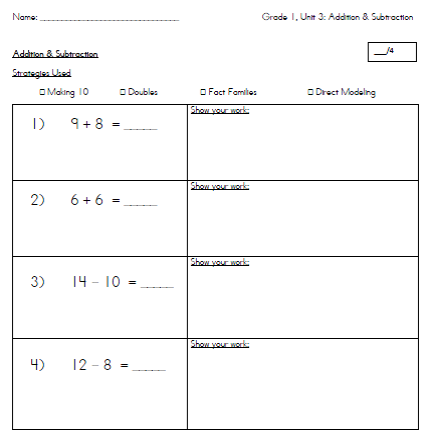
1st Grade: Addition & Subtraction Unit Test

We have been talking a lot about formative assessment this quarter and ways that we can check in with our students at the end of each lesson and the end of each unit.

For unit tests, it is best to group questions by skill and see exactly what students need to work on both to make reteach groups and guide future instruction based on student work. Here is a sample unit assessment for the 1st grade Addition & Subtraction Unit. Make sure that when grading, you pay close attention to the strategies that the students used as this unit is based on teaching strategies for quick addition and subtraction. We want to see students moving away from direct modeling and towards mental math strategies. You can get so much information beyond just correct and incorrect!

Please let me know if you need a copy in word to make edits :)

Have a great Monday!

Friday, October 24, 2014

1st Grade: Using 10 to add 9

There has been a lot of talk recently about how to get our 1st graders adding and subtracting fluently. It is challenging to build and a lot of students just are not visualizing these strategies and using them independently.

Yesterday, I watched an amazing small group lesson with Ms. A at KAO. She was using a double ten frame mat and unifix cubes to model moving
the cubes around to make ten.


It is really important for students to understand that addition is just a faster way to count, so you can move things around and still get get the same sum. She was showing them that the amount of cubes were not changing, just moving so you can make it easier for yourself and still get the same sum.

If students do not have quick and easy strategies for adding 10, this lesson will not go well. They need to know that adding 10 is easier and be able to do that quickly to make this strategy worthwhile.
Thank you Ms. A for doing such an excellent job on this lesson and letting me jump in and teach with you :)  


Saturday, October 18, 2014

1st Grade: Adding Doubles & Doubles Plus 1

Addition strategies help students do mental math quickly in their heads and lead to automatically with math facts. Teaching these strategies is difficult and it takes students awhile to really get it.

The first step is getting student "buy in". The already know how to add 2 + 2 by drawing circles or counting on, we need to convince them that this new "magical" strategy is super cool and going to help them do math facts in a snap!

In order for students to use doubles to add they need to recognize doubles. They have a ton of prior knowledge about doubles and that is what makes this such an effective strategy. Start by activating this knowledge with pictures and talking about things that they know come in doubles. This will give them a visual to recognize the facts, as well as give them a solid foundation of what you mean when you say "doubles". I recommend making this an anchor chart in the classroom. 

Here is an example.


Once you have introduced the concept of Doubles Eureka math has a great strategy for using your fingers to practice doubles to ten. 
Basically, you show students the doubles facts with your fingers and say the number sentence together. 
Example: Hold up your pink finger from each hand and together say, "1 + 1 = 2". Next hold up your pink and ring finger from each hand and together say, "2 + 2 = 4." Practice each fact up to 5 + 5. Here is a visual from Eureka to show you how to model with your fingers:

Here is a game students can play to practice either independently or in small group:

Doubles Plus 1
Once students are easily recognizing and adding doubles, they can begin using this strategy to add doubles plus one. 

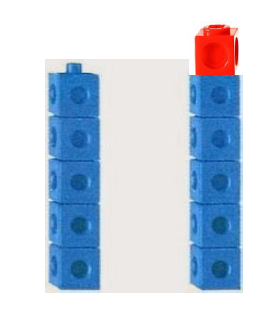
My favorite way of introducing this is with unifix cubes. Here is an example, make sure you use the color coding when you teach it!

Start by having students build a doubles fact with their cubes and write the addition sentence. 

5 + 5 = 10
Next, use a number line to decide who 5's neighbor is. It's 6!
Have students add 1 red cube to the top of one of their towers. 

5 + 6 = 11

Talk about the double in this problem, so they very clearly see that it is just 1 more than 5 + 5. Repeat this with lots of facts until they see the pattern. Next, start with the near doubles fact and see if they can build the hidden double. 
Example:
8 + 7 = 
Students would need to build 7 + 7. Once they all have it, they can add 1 red cube to the top of 1 tower to make 8 + 7. A huge part of doubles plus 1 is being able to visualize the hidden double. It will take them lots of practice and repetition to see it. 

Once you have done the doubles and doubles plus 1 lesson, focus on practicing doubles. Students should not practice doubles plus 1 until they quickly know their doubles. The only way it is an effective strategy is if they have automaticity with doubles!

Good luck and I look forward to hearing if any of these strategies help it "click" with the kids. 


Thursday, October 16, 2014

2nd Grade: Addition & Subtraction

Like 1st grade, 2nd grade will spend a majority of 2nd quarter working on addition and subtraction. In 1st grade the focus is on developing the concept of addition and subtraction, as well as fact fluency within 20. In 2nd grade, students will be modeling addition and subtraction, and adding up to 4 digit numbers with regrouping!

During Q2, we are going to really focus on 2 digit numbers, both modeling and the traditional algorithm. We will return to addition and subtraction during Q3 to build up the number of digits in the numbers students are working with.
This is a really excellent article to build your own knowledge of column addition and subtraction.

The first step in planning for such a meaty unit is to create a vision of success. What will your students be able to do at the end of the unit. We have the IA, but we want to make sure we are breaking down the skills that students need. We also do not want to wait until the end of the quarter to assess.

Here is a sample unit test for addition and subtraction.

Breaking down addition and subtraction into daily objectives can be a bit challenging. Here is an example of how I broke them down and the sequence that I would teach them.

Students are going to start by wanting to directly model because that strategy was effective with smaller numbers. The goal is to extend this understanding to directly modeling with place value blocks, rather than drawing 84 circles.  Using graphic organizers will help them effectively use the blocks to add and subtract.
Surfin Through Second has some great activities

Once they understand how to add and subtract place value blocks, they are ready to use the algorithm as way to record what they are doing with the blocks.

Once you have your unit level planning done, here are some resources to help with daily planning:

It is important to teach addition and subtraction together so students understand the relationship between them. Adding to check your subtraction is a great strategy to ensure you got the correct answer and to practice addition while working on subtraction. Here is a center that focuses on checking subtraction with addition.

This unit is going to be very heavy on word problems because students rarely use subtraction and addition with context. Resources for teaching problem solving are coming soon.

Here are some great centers and activities, check out Stage E

Mrs. Lemons Blog has some amazing resources for teaching all things 2nd grade, here are some addition and subtraction freebies
Here is a great video modeling how to encourage students to use multiple strategies. With the new TEKS students need to be able to model with pictures and place value blocks, not just the traditional algorithm. 

Brain Pop Jr is always a great way to reinforce these concepts during transitions or down time. Email Amanda if you need the KAPS login :) 

I will continue to hunt for high quality resources and share what I find!

Wednesday, October 15, 2014

1st Grade: Addition and Subtraction

Teaching the basics of addition and subtraction is a huge responsibility for 1st grade teachers. This is where the foundation is laid that they will need to be successful in Math.

With that said, here are some resources to help teach addition and subtraction to 1st graders :)

Here are some great books and articles that have a ton of excellent resources on teaching early addition and subtraction.


Here are a few awesome Math Start read alouds that can be used both as a literacy read aloud and to reinforce the math concepts:
·         Animals on Board (addition)
·         Elevator Magic (subtraction)
·         Mall Mania (addition strategies)

Great resources to use for student work or centers:

*This activity is great for small group or an independent work center. Students use 2 different colored cubes to make different combinations and record the addition sentences. 

*This is a really tricky concept and this video explains it pretty well and has some great visuals of moving 1 over to complete the ten frame. It might be a bit too complicated to show students but it gives great ideas on how to teach it and showing students parts of it with strong models could be really helpful. 

Here are resources divided by topic:

Making Ten
·         Quick blog post about importance of ten: http://mathcoachscorner.blogspot.com/2012/05/importance-of-10.html
·         http://www.accomplishate.com/preschool/printables/make6-10.pdf Page 5 is a great organizer that can be used with 2 different colored unifix cubes to generate number sentences equal to ten

  Using Ten to add 9
·         http://www.brainpopjr.com/math/additionandsubtraction/makingten/preview.weml BrainpopJr video about making 10, could work well  with higher groups, again might go over their heads but has some cool visuals
·         The first few pages could be good homework for this unit https://irieclass.wikispaces.com/file/view/SLeveled+Problem+Solving+and+Homework-Grade+2.pdf 

  Fact Families
·         http://guidedmath.wordpress.com/2010/04/01/teaching-fact-families-in-guided-math-groups/ Progression on teaching concrete to pictoral to abstract (If you scroll down this page there are a TON of great resources
·         I especially like this awesome conceptual lesson http://illuminations.nctm.org/Lesson.aspx?id=329