Showing posts with label 1st Grade. Show all posts

Wednesday, September 9, 2015

Norman the Number Rack!

1st and 2nd grade have been doing a ton of work with the number rack during Unit 1 and Kindergartners will get to join the fun in Unit 2. The number rack has been incredible in helping students visualize and decompose numbers, subitize, develop strategies for adding and subtracting, compare numbers, and so much more!

Some teachers have made the number rack even more fun and exciting in the classroom...meet Norman!


This is a great anchor chart from Ms. A at KALE to remind students where to start and what the different sides of the number rack mean. She also has an awesome system and organization for distributing their number racks during carpet time. 


Such fun ideas to make math even more exciting!


Wednesday, August 19, 2015

Number Racks!

Today was an exciting day in 1st grade because not only did students get introduced to the number rack, but they also got to make their own! 2nd grade also got to do this earlier in the week.

Students were so interested in the number rack and could not wait to show their combinations on the large teacher model. It is incredible how much the number rack helps students how numbers can be broken down in many ways.


Tip: Don't worry about your students getting the number rack that they made each time you work with them in class. They are just a class tool that everyone contributed to building, so it doesn't matter if they are using their own or not! Many teachers chose to not even have student's write their names on them - this will really help with efficiently distributing them for lessons (especially since they are frequently used for quick warm ups!)

You have a large display Number Rack that came in your kit, but the Math Learning Center also has an app you can download. 

Here is a great video about how to use Number Racks with students. 

Finally, here is a link to more great activities you can try!


Thursday, August 13, 2015

1st Grade Popsicles

All week 1st graders have been doing different activities through the context of Popsicles. The goal of this very first module is to expose students to different mathematical concepts, allow the teacher to informally assess what background information students are coming in with, and practice many different routines and procedures they will use throughout the year. The primary math in this unit is counting by 2's and working with students to develop more fluency with skip counting.

It is completely fine that students need more practice counting, using white boards, and reading graphs. The beauty of Bridges is that everything will spiral back in later units. Here are some awesome popsicle charts, graphs, and student problem solving work.


Tuesday, April 28, 2015

Bridges Implementation: Four Tips

We are so excited to begin using Bridges as our primary resource for teaching math next year! There will definitely be some bumps along the way, but we know it is going to be great for our kids. I frequently read the Bridges Implementation blog and want to share some tips that were posted by a teacher implementing Bridges for the first year.

Tip #1: Routines for Talking & Sharing
Think, pair, shares are a major part of the Bridges math lesson. Make sure you set up strong routines for sharing with partners and sharing with a whole class. When time to share as a class, think strategically about who you want to share: random by Popsicle stick? student who you listened in on during the pair portion?
Tip #2: Select which problems you will work through
Time is going to be tight. We are taking lessons that were intended to be taught in a whole group model and putting them into a rotational model. We will have to keep lessons moving, and may not have time to do all the examples every day. When reading the lessons, think about which problems are most important to the days work. Be strategic with your time!
Tip #3: Use your small group time well!
There will be recommendations in unit plans for what to do during small groups, but it is up to you as the teacher to know your kids and what they need. Make the most of your small group time, and differentiate for each group.

Tip #4: Know the objective for the day
Bridges does an amazing job of constantly introducing and spiraling related concepts in a days lessons, but know exactly what your kids need to know on a given day, from a given lesson. Having a clear vision of the goal for the day will help you cut back the lesson and fit in the allotted time and keep your lesson focused. 


Tuesday, April 21, 2015

Awesome Resource: Word Problem Generator

Last week in Boston, I was able to hear Greg Tang speak and it was incredible! I could have listened to him talk about strong math instruction all day. Besides being a great speaker and mathematical thinker, Greg Tang also write children's books about math. If you have not checked them out, I highly recommend them. A few of my favorites...


During his talk, he shared a new free resource on his website

With this tool, you can select an operation, problem time, location of the unknown, and the number range. You can either print a list of problems or you can display to project and work on together as a class. Students can also use this independently. There is a hint button that will give them a model to help solve. It is a really awesome tool!


Monday, April 20, 2015

Guess My Number

Last week, I was in Boston at the NCTM conference and learned lots of great things that I am excited to share. 1 great session was hosted by Math Solutions (Marilyn Burns) company and focused on using the ten frame to play games and build numeracy. This game is really simple, does not require a lot of prep, and has lots of built in differentiation opportunities.


Game 1: Guess My Number with the Ten Frame

Materials Needed: Ten Frame, two colored chips

In this activity, you will give students a series of clues and they will build a guess of your number on their frame. After each clue, students should have the chance to talk through their predictions and why it is a good guess. Really focus on the discussion and why their predictions are changing.

Here is an example string of clues:
1) My number is more than 6
2) My number is less than 9
3) My number is even

You can mix the clues up to review any content that your students are struggling with (doubles facts, multiples, 1 more/ 1 less, so many possibilities!) Make sure your last clue gives them enough information to figure out the number.


Sunday, February 15, 2015

Focus on Fluency: Red Light/ Green Light: Couting by Ones

Counting practice daily is really important because it helps students build and maintain counting skills, as well as serves as a foundation for adding and subtracting within 100.

Here is a quick and easy game that will both practice counting and help kids get their wiggles out.

1) Say a number between 1 and 100.
2) When you say "green light" students begin running in place and counting aloud together, beginning with the number you said.
3) When you say "red light" students stop counting and freeze.  Any students who are still counting or moving after you say "red light" sit down until the next game.
4) Continue playing starting with a new number each time you say "green light".
5) Play until only a few students are left standing, then have everyone stand and play again.

A suggested sequence of start numbers: 15, 28, 35, 48, 55, 68


Thursday, February 12, 2015

Focus on Fluency: Shake Those Disks

Here is another fun activity from Eureka math that can be used to build fact fluency. This one takes a bit of prep work and probably about 5 - 10 minutes to play.

Students will play in partners, for each pair you need:
(6) two color disks, beans, or coins (you can make them by spray painting one side of beans)


(1) Shake Those Disks 6 board

Instructions:
1) Once students are in partners, tell them they will take turns as the "shaker" and "recorder".
2) The shaker shakes the beans and tosses them on the table.
3) The recorder then records the roll on the Shakes Those Disks board.
Example: If the shaker tolls 4 red and 2  white, the recorder puts an X on the graph above the 4 and 2 number bond.
4) Players switch roles.

You can play this with any amount of beans, depending on which facts you want to focus on. The goal is for students to build automaticity with facts within 10. 

Have fun!

Tuesday, January 20, 2015

Focus on Fluency: Happy Counting

I have been reviewing Eureka Math to see if it would be a good resource for our teachers to use next year. One strength that the program has is fluency routines. Each day there are awesome routines that teachers can use to build fluency in counting and operations. Here is 1 of them:

Happy Counting

Explanation of Signals:

Count up                                          


Count down                                              


Stop


1) Tell students what you want them to count by and what number to start on (example: by ones starting at zero)
2) Point up as students count, signal to stop, and switch directions. Continue, mixing up.
3) Students play for 30 seconds with a partner.


This could also be a fun brain break for students to get up, move around, and play with friends. Try it out and let me know what you think!

Tuesday, December 16, 2014

Independent Practice Resource

We are currently looking into several different curricular resources to use for Elementary Math next year. One of the resources that we are looking at has some great workbooks available for free online!

We would love for you to take a look, use in your classroom, and let us know what you think!


Here is the link

Tuesday, December 9, 2014

1st Grade Numbers to 99

Here is a unit test to help plan the Numbers to 99 Unit and to check student mastery at the end of the unit. 


1st Grade Geometry & Fractions

Next quarter, 1st grade is working on Geometry and then allowing students to extend their knowledge of shapes to fractions. It is a fun unit with lots of great read alouds and a ton of engaging activities that the students will love.

Here is a unit plan that can be used (aligned to the TEKS) and a unit assessment to gauge student mastery. Enjoy!


Wednesday, December 3, 2014

Probability Unit Test

1st grade is finishing up their probability unit, such a fun topic!

Here is an assessment that can be given at the end of the unit to see which individual topics students mastered and what they need more work on.

Sorry it is coming out so close to unit assessment day, hopefully it will still be helpful!

Let me know if you want the word version to edit, the formatting and fonts just might be a bit off.

Wednesday, November 12, 2014

Time for Review!

Over the next couple weeks, all grade levels are starting to review content from the first Semester in preparation for IA 2. Review days can be tricky, but can also be really fun. Some review days are taken up with lessons that need to be retaught using a full lesson cycle. Other days can be more of a mixed review, so here are some ideas for the days that are mixed:


  • Break your kids into rotation groups based on what they need to practice as measured by unit tests. You can pull a group to practice addition and subtraction, another to practice geometry, and a third to practice multiplication. It is a great way to give your students exactly the review that they need. 
  • Create a grid where students can walk around and "Find someone who" knows how to solve a problem on their paper. Here is an example:
  • Create a Jeopardy game with practice review questions that students can work to solve.
  • Buddy Problem Solving: Create a packet of problems that get progressively harder. Students work with leveled partner to get through as many as they can. 
  • Create review centers that students can practice, based on what they need to work on. Math Wire & K-5 Math teaching resources have a ton of good ones for free. 

I will keep an eye out for some awesome review happening in your classroom to share with others!

Tuesday, November 11, 2014

Probability

Probability is really fun to teach...will it probably happen? Probably not? It is so applicable to real like and they love predicting the outcomes of things.

There are a ton of different activities involving skittles and spinners, but here are a few of my favorites:


  • Give out raffle tickets throughout the unit and talk about how they can increase their chances of winning. This is a great way to invest them, build background knowledge, and help them understand probability based on experience


Enjoy!

Thursday, October 30, 2014

Chartchums: Guide to Great Anchor Charts

Anchor charts are a great tool in early elementary classrooms. They give students visual reminders, record the learning, and are great reference tools. My favorite resource for charting is the website Chartchums. They have tons of examples of great charts on the blog, such as the one below.
They also wrote an entire book  devoted to charting in the K-2 Classroom focusing on Math, Science, and Social Studies. Pretty awesome!

Happy charting!

Wednesday, October 29, 2014

1st Grade: Fact Fluency

Addition and subtraction fact fluency is challenging to teach because students need a lot of practice and cannot be expected to know all their facts at the end of a single lesson. Having a bilingual model with 2 classrooms has a ton of advantages, with one being an additional math block to work on number fluency and problem solving. While students are working on fact strategies in the primary language of instruction, there are several routines that can be done in the supporting language to push them to mastery of these important facts.

Below are 3 very important types of facts and a couple routines that could be done daily to practice:


  • Making Ten
    • Students find a partner on the carpet. Partner A hold up any amount of fingers that they choose. Partner B holds up the rest of the fingers necessary to make 10 and says the number sentence.
Example:
Student A holds up 4 fingers
Student B holds up 6 fingers and says "4 and 6 is 10"
Then students switch and partner B holds up fingers first
    • Teacher flashes a ten frame and students hold up how many more they need to make 10.

Example:
Teacher shows the following ten frame:
Students hold up 1 finger, and together say "9 and 1 is 10"


  • 10 more/ 10 less
    • Practice counting by tens, starting with any number on the hundreds chart.
Example:
Point to 6 on the hundreds chart and students count, "6, 16, 26, 36". Talk about and make notes of patterns when counting by tens (which is the same as adding ten). You can see the first day of the chart, we started at 6 and the second day we started at 3. You can continue to use the same chart and just document with different colors for multiple days.
    • Flash a dot card as the starting numbers. Students write what is 10 more on their whiteboard.
Example:
Students would write 15 on their white board because 10 more than 5 is 15

  • Doubles 
    • You  can play the same game that students played using their fingers to practice making 10. Partner A holds up fingers, Partner B has to hold up the same amount and say the doubles fact. 
    • You can also play the dot card game from 10 more. Hold up a card and they double it
Example

Students write 5 + 5 = 10

Students love playing math games and these are quick, fun whole group routines that will really help your students master the basic facts!

Monday, October 27, 2014

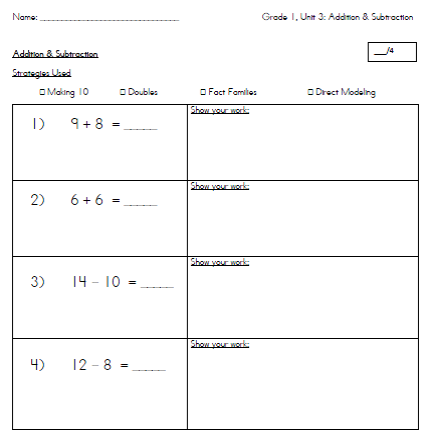
1st Grade: Addition & Subtraction Unit Test

We have been talking a lot about formative assessment this quarter and ways that we can check in with our students at the end of each lesson and the end of each unit.

For unit tests, it is best to group questions by skill and see exactly what students need to work on both to make reteach groups and guide future instruction based on student work. Here is a sample unit assessment for the 1st grade Addition & Subtraction Unit. Make sure that when grading, you pay close attention to the strategies that the students used as this unit is based on teaching strategies for quick addition and subtraction. We want to see students moving away from direct modeling and towards mental math strategies. You can get so much information beyond just correct and incorrect!

Please let me know if you need a copy in word to make edits :)

Have a great Monday!

Friday, October 24, 2014

1st Grade: Using 10 to add 9

There has been a lot of talk recently about how to get our 1st graders adding and subtracting fluently. It is challenging to build and a lot of students just are not visualizing these strategies and using them independently.

Yesterday, I watched an amazing small group lesson with Ms. A at KAO. She was using a double ten frame mat and unifix cubes to model moving
the cubes around to make ten.


It is really important for students to understand that addition is just a faster way to count, so you can move things around and still get get the same sum. She was showing them that the amount of cubes were not changing, just moving so you can make it easier for yourself and still get the same sum.

If students do not have quick and easy strategies for adding 10, this lesson will not go well. They need to know that adding 10 is easier and be able to do that quickly to make this strategy worthwhile.
Thank you Ms. A for doing such an excellent job on this lesson and letting me jump in and teach with you :)  


Thursday, October 23, 2014

Using Cubes for Problem Solving

This week Mrs. Doyle and I had a great chance to see some CGI problem solving in action. KIPP DC has done a lot of work this year to push their students thinking and problem solving skills. One big takeaway we had is that students need cubes to directly model the problem. Understanding the context of the problem and being able to show what is happening is crucial for student understanding.

The cubes should be readily available and in towers of ten, of all the same color. We keep them in towers of ten to help students with base ten thinking. When they always start with groups of ten, they are much more likely to use base ten strategies to make counting and operations more efficient.

Cubes should always be out and being used during story problem time for K-2 and can be easily stored and hassle free!


As you can see, 1 black cube got mixed into the blue cube box. You have to really work with students on keeping them organized and putting them back into tens at the end of the lesson, but that can definitely do it!